How Often Should You Feed a French Bulldog?
Establishing a consistent feeding schedule is an important part of raising a healthy French Bulldog puppy. Scheduled feeding times not only help with digestion and routine, but they can also make potty training much easier during the first several months. Many owners searching for the best French Bulldog food are surprised by how important feeding routines and portion control can be during puppyhood.
We recommend feeding puppies at scheduled times rather than leaving food available all day for two main reasons:
1) It Helps Establish a Potty Routine
A consistent feeding schedule helps owners better predict potty times. One of the simplest puppy training concepts to remember is:
Food in = food out.
2) It Helps Monitor Appetite & Health
Scheduled feedings also allow owners to monitor how well their French Bulldog puppy is eating. A puppy that suddenly refuses multiple meals, develops diarrhea, vomiting, or decreased appetite may not be feeling well and should be monitored closely.
When feeding your French Bulldog puppy, place them in a quiet area such as a crate or small enclosed space where they can focus on eating without distraction. Allow the puppy approximately 20 minutes to eat, then remove the food until the next scheduled meal. Do not panic if your puppy occasionally skips a meal, especially during periods of adjustment, teething, travel, or environmental change. Young puppies can sometimes become distracted or temporarily eat less while settling into a new routine.
We do not feed canned food to our French Bulldog puppies. Our puppies are raised on kibble from an early age. If your puppy seems hesitant to eat, you can soften the kibble with warm water or plain bone broth to create a softer texture without introducing a sudden diet change.
Our Suggested French Bulldog Puppy Feeding Schedule
Up to 3 Months: Offer food 4 times daily
3–6 Months: Offer food 3 times daily
6–12 Months: Transition to 2 meals daily and begin regulating portions rather than free-feeding
12 Months & Older: Daily food intake can typically be divided into 1–2 meals per day
Feeding times do not need to follow an exact clock schedule. The most important factor is consistency and creating a routine that fits your household and potty-training schedule.
New owners may also find our French Bulldog Adoption Guide helpful for preparing for the first weeks at home with a new puppy.
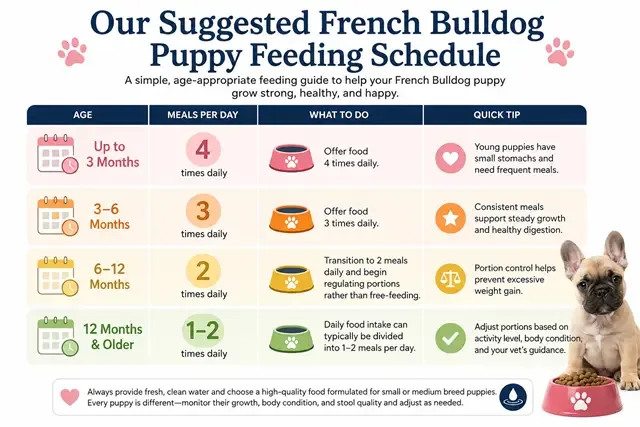
Suggested French Bulldog puppy feeding schedule from puppyhood through adulthood.
Feeding an Adult French Bulldog
Feeding an adult French Bulldog properly is extremely important for maintaining healthy weight, digestion, joint health, nutrition and overall long-term well-being. One of the most common problems seen in the breed is obesity, and many French Bulldogs can gain weight very easily if they are overfed or not receiving enough daily activity.
At Must Be Frenchies, we typically recommend feeding adult French Bulldogs once or twice daily rather than free-feeding throughout the day. For dogs fed twice daily, the total daily calorie intake can simply be divided between the two meals.
We strongly encourage owners to focus more on calorie intake rather than simply measuring food by volume alone. Every French Bulldog has a different metabolism and activity level, which means calorie needs can vary significantly from one dog to another. More active French Bulldogs may require substantially more calories to maintain healthy body condition, while lower-energy or less active dogs often require fewer calories to avoid unhealthy weight gain.
Some adult French Bulldogs may maintain an ideal weight on approximately 500 calories per day, while highly active Frenchies may require closer to 1,500 calories daily depending on metabolism, activity level, age, and overall body condition.
Careful portion control is extremely important in the breed because excess weight can place additional strain on joints, breathing, mobility, and overall health. Owners should routinely monitor body condition, energy levels, and weight rather than relying strictly on feeding charts found on dog food bags.
Finding the best food for French Bulldogs involves more than simply choosing a high-quality dog food. Proper portion control, calorie management, consistent feeding routines, and maintaining healthy body condition all play an important role in supporting a healthy adult French Bulldog.
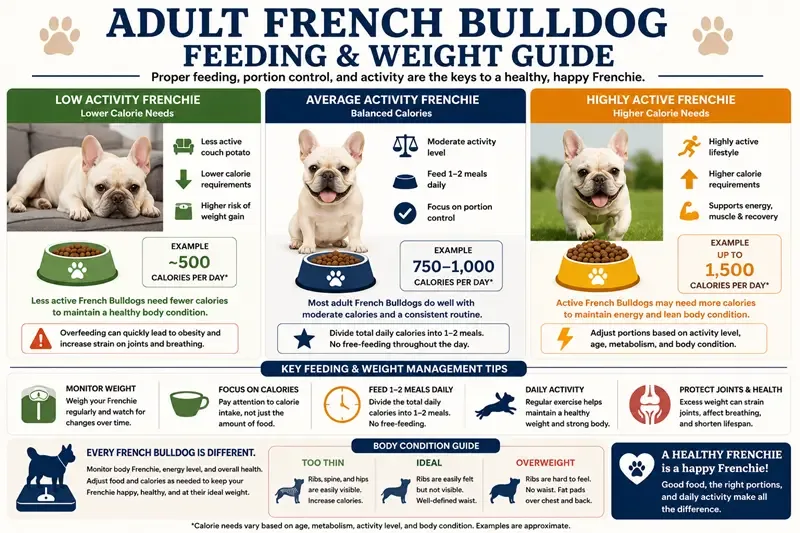
Suggested adult French Bulldog feeding and calorie guide based on activity level, portion control, and healthy weight management.
Frequently Asked Questions About the Best Food for French Bulldogs
What is the best food for French Bulldogs with sensitive stomachs?
At Must Be Frenchies, we have personally had very good results using Victor Hi-Pro Plus Classic for our adult French Bulldogs and NutriSource Small & Medium Breed Chicken and Rice Formula for our puppies. However, because all French Bulldogs are different, owners should focus less on marketing claims and more on how their individual dog responds to a particular food over time.
Is Grain Free Food Good for French Bulldogs With Sensitive Stomachs?
Not necessarily. Grain free dog food is not automatically better for French Bulldogs, and in our experience many Frenchies actually digest high-quality grain-inclusive formulas better than grain free varieties. While some dogs may have sensitivities to certain ingredients, grains themselves are not usually the problem.
At Must Be Frenchies, we generally recommend avoiding foods that rely heavily on low-quality fillers such as excessive corn or soybean ingredients. However, healthy grains such as sorghum, millet, barley, oatmeal, and rice can be excellent carbohydrate sources for many French Bulldogs and are often easier on digestion than some grain free formulas.

Finding the best food for French Bulldogs often involves patience, observation, and learning what works best for your individual Frenchie.
Over the years, we have personally found that our French Bulldogs tend to maintain better digestion, stool quality, and overall consistency on foods containing high-quality grains rather than grain free diets. As with any French Bulldog diet, paying close attention is important because every dog responds differently to specific ingredients and feeding programs.
Can French Bulldogs have food allergies?
Yes, French Bulldogs can be prone to food allergies and food sensitivities, and one of the most common protein sensitivities we personally see in French Bulldogs is chicken. While not every Frenchie has issues with chicken-based foods, some dogs may develop symptoms such as chronic ear irritation, yeasty ears, scratching around the ears and face, excessive paw licking, or recurring skin problems. Chicken is not necessarily bad for all French Bulldogs, but it can be a common protein sensitivity in some Frenchies.
Some French Bulldogs with food sensitivities may also develop painful “toe bumps,” commonly referred to as interdigital cysts or interdigital furunculosis. In some cases, ongoing digestive problems, itching, or skin irritation may improve after changing to a different protein source or adjusting the dog’s diet.
At Must Be Frenchies, we encourage owners to pay close attention to recurring skin issues, ear problems, digestion, and overall comfort when evaluating whether a particular food is working well for their French Bulldog. Because every Frenchie responds differently to specific ingredients, finding the best food for French Bulldogs with food sensitivities often involves careful observation and gradual dietary adjustments over time.
Should French Bulldogs eat wet food or kibble?
Both wet food and kibble can be beneficial for French Bulldogs, and many owners choose to incorporate a combination of both depending on the individual dog’s needs, appetite, and digestion. High-quality kibble can help provide consistent nutrition and is often easier for portion control and feeding routines, while wet food may help increase moisture intake and improve palatability for picky eaters.
At Must Be Frenchies, our puppies are raised primarily on kibble from an early age, as we find it helps establish consistent digestion and feeding routines. However, some owners choose to supplement kibble with wet food, bone broth, or softened meals to encourage appetite or add variety to the diet.
When selecting the best food for French Bulldogs, the overall ingredient quality, digestion, stool consistency, and how the individual Frenchie tolerates the diet are often more important than whether the food is wet or dry alone. As with any dietary change, new foods should be introduced gradually to help reduce the risk of stomach upset or diarrhea.

French Bulldogs are well known for loving treats, which makes portion control especially important for maintaining healthy body condition.
Why is my French Bulldog gassy?
Excessive gas is a very common issue in French Bulldogs, and one of the main reasons is because the breed is brachycephalic, meaning they have a shortened muzzle and airway structure. Because of this anatomy, many French Bulldogs swallow a significant amount of air while eating, drinking, panting, or exercising, which can contribute to increased gas during digestion.
Diet can also play a major role in French Bulldog gas and digestion. Certain foods, abrupt diet changes, overeating, low-quality ingredients, or food sensitivities may increase digestive upset and excessive flatulence in some Frenchies.
At Must Be Frenchies, we have found that feeding high-quality food, maintaining consistent feeding routines, slowing down fast eaters, and using raised food bowls may help reduce the amount of air some French Bulldogs swallow during meals. Careful attention to digestion, stool quality, and ingredient sensitivities can often help owners better identify the best food for their French Bulldog and improve overall digestive comfort.
Foods Many French Bulldog Owners Try to Avoid
When searching for the best food for French Bulldogs, many owners eventually learn that sudden diet changes and frequent food switching can sometimes create more digestive problems rather than solve them. Because French Bulldogs are known for having sensitive stomachs, abruptly changing foods may increase the risk of diarrhea, vomiting, excessive gas, stomach upset, or temporary appetite changes.
Many experienced French Bulldog owners also try to limit excessive table scraps, rich human foods, and overfeeding treats, especially in dogs already prone to digestive sensitivities or obesity. Rich foods and frequent treats can sometimes contribute to loose stools, increased gas, weight gain, or inconsistent digestion in sensitive Frenchies.
At Must Be Frenchies, we generally recommend keeping feeding routines consistent and making dietary changes gradually whenever possible. Careful portion control, slow food transitions, and avoiding constant food changes are often important factors in maintaining healthy digestion and overall condition in French Bulldogs.
Final Thoughts on the Best Food for French Bulldogs
Finding the best food for French Bulldogs often takes patience, consistency, and learning what works best for your individual Frenchie. Some dogs tolerate a wide variety of foods well, while others may need slower food transitions, portion control, or more attention to digestion and skin sensitivities.
At Must Be Frenchies, we believe quality food, consistent feeding routines, and careful observation all play an important role in maintaining long-term health and comfort in French Bulldogs. If you are struggling with your French Bulldog’s digestion, feeding routine, or food sensitivities, feel free to contact us and we will do our best to help guide you in the right direction.
If you are considering adding a puppy to your family, be sure to visit our Available French Bulldog Puppies page to see current availability.